.png)
LONG FORM STORY ANALYSIS
- NG YI XUAN
- Jan 4, 2024
- 4 min read

Overview of the long form story

The Guardian article, which titled ‘The Rise of the Deepfake and the Threat to Democracy’, delves into the rising concerns of deepfake technology in politics. Beginning with the comedic portrayal of Donald Trump by Jimmy Fallon and Barack Obama by Dion Flynn on NBC’s The Tonight Show, the article unfolds the alarming ability to convincingly replace the faces of actual political figures. It highlights the risk of malicious misuse, probing the spreading of digitally altered political content on social platforms, causing confusion and misinformation. The article underlines concerns regarding the profound impact of undetectable deepfake on public perceptions, and democracy, urging proactive measures to tackle the emerging challenges of deepfake. Key players like James and Ivan in the deepfake landscape, along with the role of the Faculty in generating thousands of deepfakes are revealed. Faculty proclaim that they aim to compile a library for training systems to distinguish real from fake video or audio. As the article questioned legislative and authentication efficacy, a resonating call to action urges leaders to pledge against using deepfake in campaigns, to protect the public’s right to informed decision-making in an increasingly technology-influenced political landscape.
Effort that can be seen in this article
Narrative elements
The article uses narrative elements. This article introduces human characters, like Jimmy Fallon, Ivan who is the Russian programmer behind DeepFace Lab, James who is the content creator, and Faculty which is a company working on deepfake detection, showing diverse perspectives on deepfake. The plot unfolds chronologically, discovering the evolution of deepfake technology from a humorous start on a TV show to potentially malicious political uses. It includes the conflict, especially surrounding the potential misuse of deepfake in politics. While lacking a clear resolution, the article raises awareness about the challenges posed by deepfakes, encouraging proactive measures. By using narrative elements, the article is making complex technological content more accessible and relatable for wider audiences.
Usage of GIFs, Audio, and Images

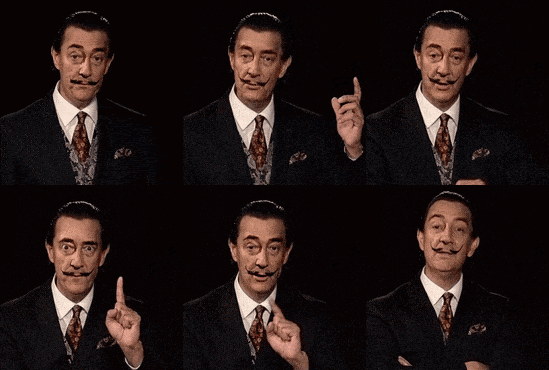




Scrolling through the article, the uses of GIFs can be seen for example when showing the normal version and deepfake version of the imitation of Jimmy Fallon. Moreover, the article includes the audio of Donald Trump created by machine learning so that readers can have an idea of what the sound created by machine learning is and whether is there any difference from the real voice. The article also includes images of deepfake using Nicolas Cage’s face across various characters, showing his population as a choice for fan fakes using DeepFaceLab. These multimedia elements enhance the readers’ experience via visual and auditory elements, making the content more engaging and informative.
Hyperlinks


The article employs inline hyperlinks, connecting readers to additional information, references or related resources. For instance, phrases like ‘the footage of the sketch was posted on the YouTube channel derpfakes under the title The President’ use hyperlinks to link to the specific YouTube video. This provides readers with a more interactive and enriched experience, encouraging readers to explore related content and gain a more comprehensive understanding of deepfake technology.
Highlights and Quotations


Highlights and quotations are used to emphasize the points to be paid attention to, such as the title, the label under the GIF, pictures, audio, and quotations. By strategically using highlights, the article can easily draw attention to information to focus in the article. In addition, the use of quotations not only enhances credibility and authenticity, but also makes the content more relatable. These elements make the article more compelling and memorable, amplifying the overall impact.
Focused content box

The article uses a focused content box that highlights how to spot a deepfake, educating the audience to identify the real information from the fake. The box acts as a valuable tool, presenting information in an organized visual emphasis. Enhancing the clarity, engagement, and retention of information within the article, the visual aid elevates the overall effectiveness of the article.
Improvement to make
Subtopic/Chapter to survey
The absence of subtopics and chapters in this lengthy article poses a readability challenge. As per the page design template, the article is arranged on the left while the references like GIFs, audio and images are on the right on a maximized page, navigating through this prolonged passage to find the specific subject can be time-consuming for readers. To handle this, consider adding a subtopic like “Evolution of Deepfakes: From Humor to Misuse '' to navigate through the various examples of deepfake usage is vital so that it can act as a guideline thread for readers. Additionally, chapters provide a structural framework, helping in mentally organizing the information and finding what readers are looking for without scrolling through the whole article. These strategic additions not only enhance the overall readability but also make it more accessible and digestible.
Different hyperlink
The article can gain more benefits from using diverse types of hyperlinks, instead of only text-based hyperlinks. For instance, the image hyperlinks. Avoiding uncertainties in referring to specific in-text links of the incident, image hyperlinks can provide a more direct reference. Consider utilizing the image hyperlinks lead to the video showcasing a fake clip of Nancy Pelosi, speaker of the US House of Representatives, slurring drunkenly through a speech. Not only will user experiences be more immersive as the reader will have a visual impact before looking at the references, but also surpass typical inline hyperlinks, making the content more captivating. It will potentially boost engagement, leveraging the compelling nature of visuals.
Timeline
The presence of a timeline act as the guidance and visual representation for key events, developments, and incidents related to deepfakes. Enriching readers’ comprehension, this visual aid also elevates engagement via presenting a chronological overview. The timeline contributes to the narrative approach of this article, facilitating an organized presentation of information. Offering user-friendly navigation, readers can easily know the specific focus of the incidents and the relationship between different occurrences without having to read through the entire article efficiently.
Storyboard

Website link: https://www.theguardian.com/technology/ng-interactive/2019/jun/22/the-rise-of-the-deepfake-and-the-threat-to-democracy



Comments