.png)
Weaving Timeless Tales: Exploring The Art of Rattan Craftsmanship
- NG YI XUAN
- Feb 29, 2024
- 4 min read

Updated: Feb 29, 2024
By NG YI XUAN, 28 February 2024, 11.30 pm
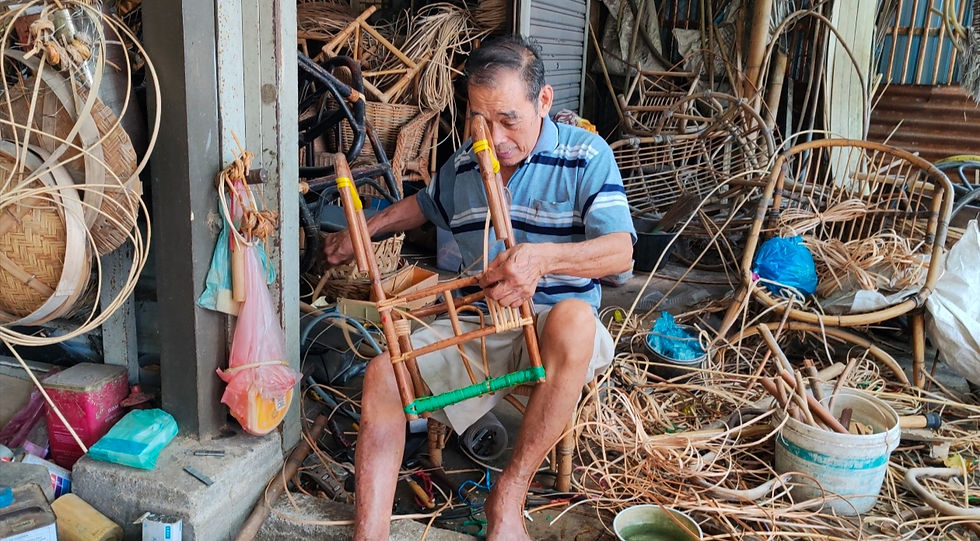
(Photo of Choong repairing a rattan product, taken by NG YI XUAN)
As the morning sun casts its warm glow upon the workshop, Choong Kean Soon will be seated in his rattan chair, starting his business in repairing the old rattan products, and selling the rattan products in his shop. For Choong, every twist and turn of the fibers contains the memories of him and his father. With practiced hands, he started his ritual of weaving the rattan. Choong breathes life into the age-old tradition of rattan craftsmanship throughout his years of effort.
For over 6o years, Choong Kean Soon, aged 80, has dedicated his life to the timeless art of the traditional rattan craftsmanship for more than 60 years. His workshop, steeped in history, has been a cornerstone of the area long before Malaysia gained independence, and continues until today.

(Photo of the shop, Weng Giap, taken by NG YI XUAN)
Choong mentioned that he inherited the craftsmanship from his father when he was 12 years old.
“In the past, we didn't have access to books or the opportunity to attend school.”
Choong mentioned that completing primary education was often unattainable for many of them in the past. Their survival option was only to master a skill, such as this craftsmanship, to sustain themselves. Without these skills, it will be challenging to secure enough food on the table. “Life in those days was harsh,” he said.
Not like doing great business, he sadly expressed that this craftsmanship is not a job to make money. If it were profitable, he would gladly stop working and leisurely live a retirement life.
He proudly said that he is able to master the skill in a while, without encountering any challenges during the learning process. However, he humbly acknowledged his limitations, admitting that his expertise may not extend to all kinds of rattan craftsmanship.

(Comparison between two rattan chairs with different material, taken by NG YI XUAN)
“In making rattan products, you need to know what materials it is made of.”
Talking about rattan products, there are different types of materials including rattan skin and rattan cane. There will be different outcomes using different materials. Due to the handmade product of the rattan, he clarifies that the process will be slower compared to the machined-made ones.
Moreover, Choong said that the sale of rattan products depends on the customers’ personal preference, some will like vintage items and some will prefer newer products. It depends on what people are looking for at the time.
Yet, he mentioned the benefits of using rattan products. Take the rattan chair as an example, it is created in a ventilated bottom, providing better airflow for a more comfortable and healthier seating experience. Unlike plastic chairs that lack ventilation and can lead to back pain and discomfort from heat accumulation, rattan chairs remain cool even after prolonged use in a day, unlike cushion chairs that can make one’s buttock feel uncomfortably warm.
“Rattan products are indeed more environmentally friendly. They can be repaired if damaged, allowing them to last for decades,” he said.

(Photo of Choong finished repair a product, taken by NG YI XUAN)
Talking about the price, he states that the prices between the products might vary, as the quality of the items can differ. Higher quality products tend to be priced higher, while lower quality ones are priced lower.
The price will be affected by various reasons too. He mentioned that the rattan materials were inexpensive in the past, but now the prices have gone up. Both the cost of materials and labor have also increased over time, therefore rattan products will be more expensive nowadays.
This craft is fully done by hand, not by machines. “Once you stop working, you can’t meet the deadlines,” he said. Machines are unable to replace craftsmanship. Choong voices his opinion that this skill wouldn't hold its value if machines could replace it.

(Photo of Choong with his customer, taken by NG YI XUAN)
“I don’t actively seek out new business opportunities anymore.”
Given his workshop's long-standing presence, Choong’s customer base consists primarily of returning clients. He mainly focuses on repairing old chairs and selling products including rattan chairs, and household products like steamers in his workshop, a service sought after by his loyal customers as the rattan may wear and break over time, prompting customers to seek his expertise.

(Photo of Choong repairing the product with a tool, taken by NG YI XUAN)
“This craft is definitely becoming rarer as time goes on. With no one willing to take over, once the older generation is gone, there will be fewer craftsmen left.”
Choong expressed his regret that no one wants to learn this craft anymore, even if he offers to teach. His own son is also not interested in inheriting the craftsmanship. He believes the younger generation is more into computers, so that this craft is considered outdated and obsolete.
Even though Choong is at retirement age, he will keep working on this craftsmanship, continuing until he is physically unable to do anymore.
YouTube Video
Facebook Post

Instagram Post


Comments